


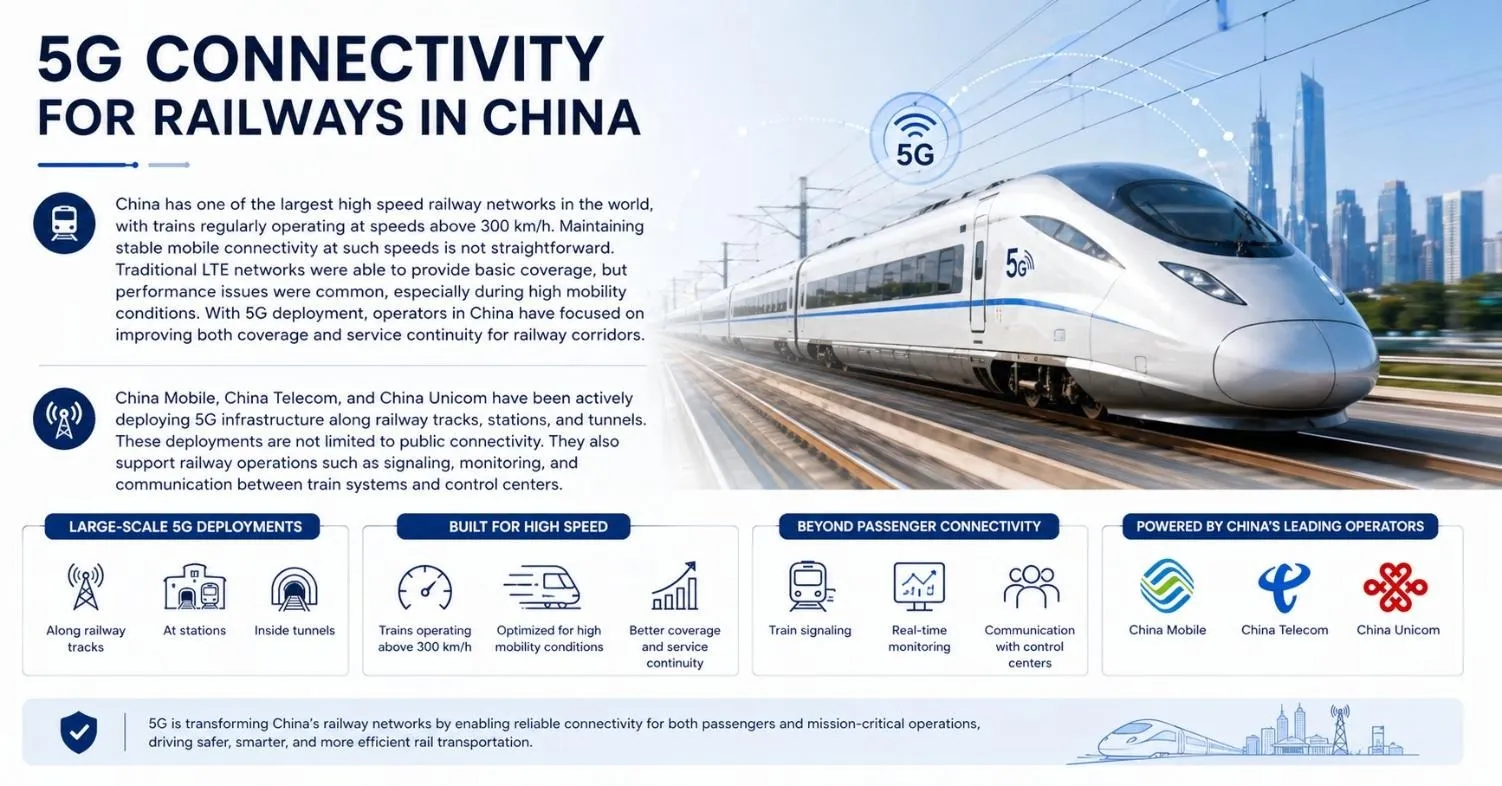
China has one of the largest high speed railway networks in the world, with trains regularly operating at speeds above 300 km/h. Maintaining stable mobile connectivity at such speeds is not straightforward. Traditional LTE networks were able to provide basic coverage, but performance issues were common, especially during high mobility conditions. With 5G deployment, operators in China have focused on improving both coverage and service continuity for railway corridors.
China Mobile, China Telecom, and China Unicom have been actively deploying 5G infrastructure along railway tracks, stations, and tunnels. These deployments are not limited to public connectivity. They also support railway operations such as signaling, monitoring, and communication between train systems and control centers. So, now let us look into Railway 5G Connectivity in China along with Accurate LTE RF drive test tools in telecom & RF drive test software in telecom and Accurate 5g tester, 5G test equipment, 5g network tester tools in detail.
Challenges in High Speed Railway Connectivity
Railway environments introduce a set of technical challenges that are different from typical urban or rural deployments.
1. High Speed Mobility
At speeds above 300 km/h, a device moves across multiple cells within a short duration. This creates frequent handovers. If handover timing is not optimized, users experience call drops, session interruptions, or data loss.
In LTE networks, this was a major limitation. With 5G, improvements in handover signaling and beam management have reduced some of these issues, but the problem is still present and requires careful tuning.
2. Doppler Shift and Signal Variation
High speed movement causes Doppler shift, which affects signal quality. The faster the train moves, the more noticeable the shift becomes. This impacts modulation and decoding at the device level.
Engineers in China address this by optimizing frequency usage and adjusting network parameters for railway scenarios. Lower frequency bands are often used for wider coverage and better stability.
3. Coverage Gaps in Tunnels and Remote Areas
Railway lines pass through tunnels, mountains, and rural regions. These areas are difficult to cover using standard macro sites.
To handle this, China uses:
- Leaky feeder cables inside tunnels
- Distributed antenna systems (DAS)
- Small cells placed along tracks
This ensures continuous signal availability even in enclosed environments.
4. Interference and Multi Cell Overlap
In dense deployments, multiple cells overlap along the railway track. While this helps maintain coverage, it can also introduce interference if not managed properly.
5G networks in China use advanced interference management techniques and beamforming to reduce these issues.
Network Architecture for Railway 5G
Railway connectivity in China is designed using a combination of macro cells, small cells, and dedicated infrastructure.
1. Macro Cell Deployment Along Tracks
Base stations are installed along railway lines at regular intervals. Antennas are tilted and aligned to follow the track direction rather than covering wide areas.
This creates a linear coverage pattern, which is more suitable for moving trains.
2. Beamforming and Massive MIMO
5G networks use beamforming to direct signals toward the train. Instead of broadcasting in all directions, the network focuses energy toward the moving device.
Massive MIMO antennas adjust beams dynamically as the train moves, which helps maintain signal quality.
3. Dual Connectivity (LTE + 5G)
In many railway deployments, devices remain connected to both LTE and 5G networks. This ensures service continuity in case one layer experiences issues.
LTE acts as a fallback, while 5G provides higher data rates when available.
4. Edge Computing for Low Latency
For operational use cases such as train control and monitoring, low latency is required. China has deployed edge computing nodes near railway networks to process data closer to the source.
This reduces delay and improves response time for critical applications.
Use Cases Beyond Passenger Connectivity
Railway 5G in China is not limited to internet access for passengers. It supports several operational functions.
1. Train Control and Communication
Real time communication between trains and control centers is required for safe operation. 5G provides a reliable link for this exchange.
2. Video Surveillance
High resolution cameras installed on trains and stations transmit video data continuously. 5G enables high bandwidth transmission without significant delay.
3. Predictive Maintenance
Sensors installed on tracks and trains send data to monitoring systems. This data is analyzed to detect faults before they cause failures.
4. Passenger Services
Passengers use 5G for streaming, video calls, and other applications. High speed connectivity improves user experience during travel.
Testing and Validation Approach
Given the complexity of railway environments, network testing is a continuous process in China.
1. Drive Testing on Trains
Engineers perform testing using devices placed inside trains. These devices collect data while the train is in motion.
Parameters collected include:
- Signal strength
- Throughput
- Latency
- Handover success rate
2. L1 / L2 / L3 Logging
Protocol level logging is used to analyze network behavior.
- L1 logs show signal quality and radio parameters
- L2 logs show scheduling and retransmissions
- L3 logs show handover signaling and session management
This helps identify issues such as:
- Delayed handovers
- Resource allocation problems
- Signal drops during transitions
3. Tunnel and Indoor Testing
Special testing is performed inside tunnels using DAS or leaky feeder systems. Engineers check signal continuity and handover behavior at tunnel entry and exit points.
4. Multi Device Testing
Multiple devices are used to simulate different carriers and services. This helps compare network performance across operators.
Current Progress in China
China has already achieved large scale deployment of 5G along major railway routes, including:
- Beijing–Shanghai high speed rail
- Guangzhou–Shenzhen corridor
- Chengdu–Chongqing route
These routes are equipped with continuous 5G coverage, including tunnels and stations.
Operators are also working on improving uplink performance, which is important for video transmission and real time data sharing.
Future Direction
China is also preparing for next generation railway communication systems.
1. Integration with 6G Research
Future railway networks may use higher frequency bands and advanced communication methods. Research is ongoing to support even higher speeds and lower latency.
2. AI Based Network Optimization
AI is being used to adjust network parameters dynamically. This helps manage handovers and resource allocation more efficiently.
3. Satellite Integration
In remote areas where terrestrial coverage is difficult, satellite communication may be used along with 5G.
Conclusion
Railway 5G connectivity in China is built around high speed mobility, continuous coverage, and stable performance. The network design is different from standard deployments due to the linear movement of trains and the need for consistent connectivity.
Operators use a mix of macro cells, small cells, DAS, and advanced radio techniques to maintain signal quality. Testing plays a major role, especially with protocol level logging and real time analysis.
As railway systems continue to evolve, connectivity requirements will increase. China’s approach shows how large scale deployment and detailed network validation can support high speed transportation systems effectively.
About RantCell
RantCell is an easy to deploy network testing platform that turns any Android smartphone into a powerful testing tool for 4G and 5G networks. It enables teams to perform drive tests, indoor testing, and real time benchmarking without the need for expensive traditional tools.
From basic KPI tracking to advanced analysis such as uplink performance, band locking, and protocol level insights, RantCell helps teams identify issues faster and make data driven decisions for network optimization. Also read similar articles from here.